Explosion protection document
Why it is needed
An explosion protection document is what you show at an inspection or after an incident – without it you can show neither that the explosion risks have been mapped according to the ATEX rules nor that the right protection is in place.
What the service is
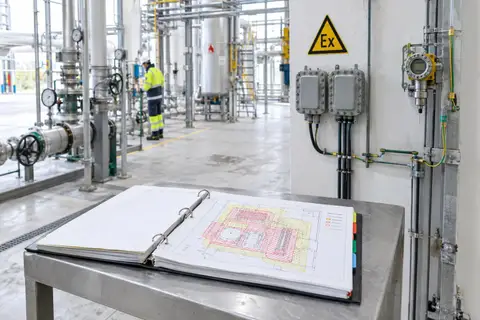
Do you professionally handle flammable gas, flammable liquid or combustible dust that can form an explosive atmosphere? Then the zone classification and the assessment of the ignition risk must be documented – what is usually called an explosion protection document. We produce complete documentation describing which substances can create a hazardous atmosphere and their properties, the classification with zone extent (drawing and table), the ignition source assessment, procedures for safe work in and near potentially explosive atmospheres, and instructions for dealing with spills, leaks and releases.
Who is required to have this
The requirement follows from the ATEX workplace directive 1999/92/EG and applies to businesses where an explosive atmosphere (gas, vapor or dust) can form – whatever the size of the business. In Sweden the requirement is split between two authorities: for flammable gases and liquids, regulations SRVFS 2004:7 of the Swedish Civil Defence and Resilience Agency (Myndigheten för civilt försvar, MCF, formerly MSB) apply, and for combustible dust and liquids with a flash point above 100 °C, regulations AFS 2023:10 of the Swedish Work Environment Authority (Arbetsmiljöverket) apply.
Regulations that set the requirements
- SRVFS 2004:7 – regulations on potentially explosive atmospheres when handling flammable gases and liquids (administered by MCF); require zone classification, an assessment of the ignition risk and documentation of both, which must be revised before significant changes to the business. The documentation requirement applies to professional handling
- AFS 2023:10, 9 kap. – the Swedish Work Environment Authority's regulations on risks in the work environment; require zone classification and an explosion protection document where an explosive atmosphere is caused by combustible dust (and liquids with a flash point above 100 °C). The regulations' general rules on chemical risks also apply when handling flammable gases and liquids
- SS-EN 1127-1 – the standard for explosion protection: basic concepts and the methodology the risk assessment in the explosion protection document is based on
- SS-EN IEC 60079-10-1 and SS-EN IEC 60079-10-2 – the standards for zone classification of explosive atmospheres, for gas or vapor atmospheres and dust atmospheres respectively; which one is used depends on the substance handled.
This is a guide and does not replace checking the current consolidated legal text, permit conditions or municipal practice.