ATEX zone classification
Why it is needed
An incorrect zone classification can lead to the wrong equipment being chosen. We make sure the result holds up before it becomes part of the plant's safety documentation.
The requirement to classify areas with an explosive atmosphere comes from two complementary sets of regulations: SRVFS 2004:7, which covers the handling of flammable gases and liquids, and AFS 2023:10, whose provisions on potentially explosive atmospheres mainly cover combustible dust. We deliver the result as a classification drawing and a classification table, normally produced with the support of SEK Handbok 426, ready to be included in the explosion protection document.
What the service is
SEK Handbok 426 is the Swedish handbook for classifying hazardous areas with flammable gas, liquid or vapor. It contains the European standard SS-EN IEC 60079-10-1 in Swedish and English, supplemented with Swedish classification examples. The handbook describes how the type and extent of a zone are determined from the grade of release (continuous, primary or secondary), the release rate, and the effectiveness and availability of the ventilation.
We help you assess where an explosive atmosphere can form and how far the hazardous areas extend. With the support of calculations and documented assessments, we produce or update the zone classification for your plant.
The work starts from the plant's own conditions, such as the substances handled, release sources, operating conditions and ventilation. Assumptions and assessments are set out so that you can understand the documentation and use it in design work, equipment selection and changes to the plant.
You receive classification documentation that, depending on the scope of the assignment, contains:
- A classification drawing showing the location and extent of the zones.
- A classification table with the relevant information for each area, including gas group and temperature class.
- Calculations with the input data and assumptions set out.
- The reasoning behind the assessments and the chosen zone classification.
- Identified needs for additions or further investigation.
You receive the documentation that is required.
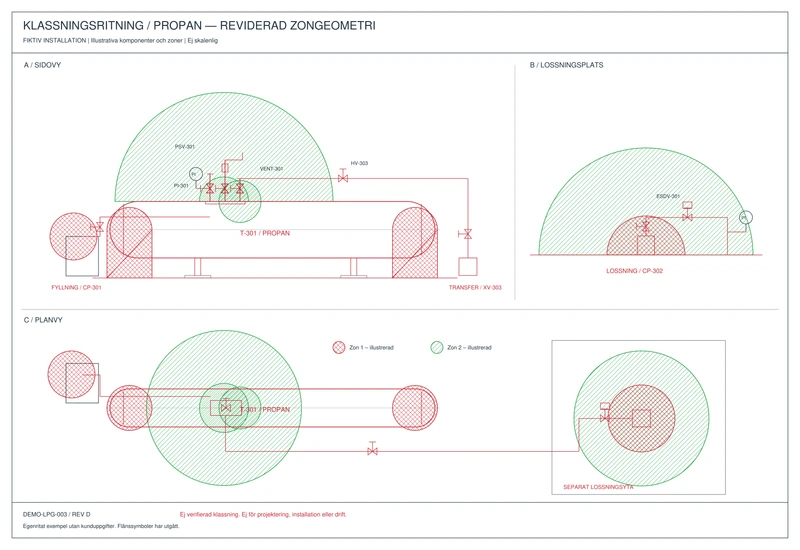 Enlarge the drawing
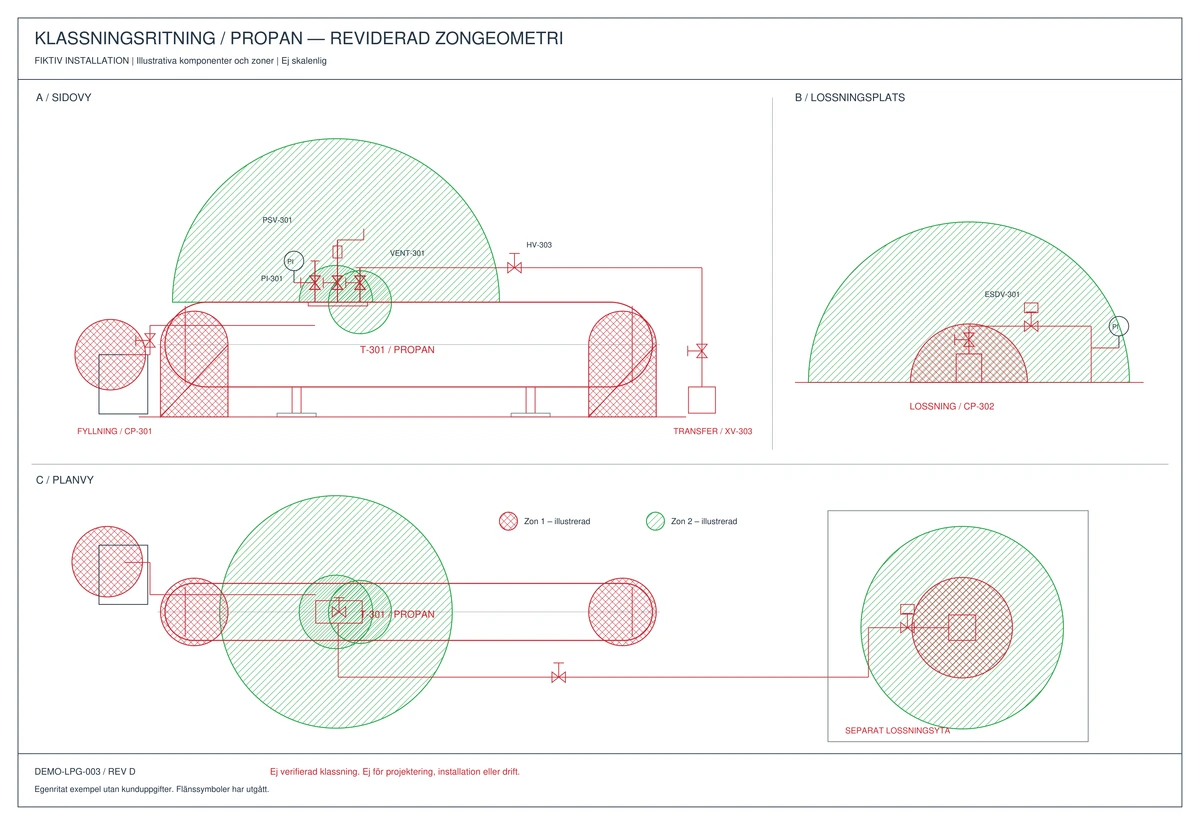
We help you both with new installations and when an existing classification needs to be reviewed after changes in handling, a conversion or changed operating conditions.
We adapt the scope to the customer's needs.
Correctly sized zones – neither too large nor too small.
A zone that is too small is a safety risk – a residual risk of ignition (undersizing). A zone that is too large imposes requirements on equipment and ways of working over a larger area than needed – which means unnecessarily high costs (oversizing). The size is determined by the classification calculation, so that the zones are right.
Who is required to have this
The requirement for zone classification follows from the ATEX workplace directive 1999/92/EG, which is implemented in Sweden through SRVFS 2004:7 (flammable gases and liquids) and AFS 2023:10 (combustible dust). It applies to businesses where an explosive atmosphere can form. The classification must be documented and is normally carried out according to SS-EN IEC 60079-10-1 – in Sweden usually with the support of SEK Handbok 426. The ATEX product directive 2014/34/EU in turn sets the requirements for the equipment used in the zones.
Regulations that set the requirements
- SRVFS 2004:7 – regulations on potentially explosive atmospheres when handling flammable gases and liquids (administered by MCF); require hazardous areas to be divided into zones 0, 1 and 2 and the extent of each zone, as well as the gas group and temperature class, to be determined
- AFS 2023:10, 9 kap. – the Swedish Work Environment Authority's regulation; requires zone classification (zones 0–2 or 20–22) where an explosive atmosphere is caused by combustible dust or liquids with a flash point above 100 °C, according to the applicable European standard or in another way that gives at least an equivalent level of protection
- SS-EN IEC 60079-10-1 and SS-EN IEC 60079-10-2 – the standards for zone classification of explosive gas or vapor atmospheres (zone 0/1/2) and dust atmospheres (zone 20/21/22) respectively; which one is used depends on the substance handled. SEK Handbok 426, which we use, is based on SS-EN IEC 60079-10-1
This is a guide and does not replace checking the current consolidated legal text, permit conditions or municipal practice.
Source: SEK Handbok 426, utg. 6:2023 — Svensk Elstandard (elstandard.se)